Impact Assessment Report
Service Civil International (SCI) is an international voluntary service organisation established in 1920. It consists of 40 branches and groups in every continent and of more than 90 partners all around the world.
This report highlights the difference SCI’s initiatives are making around the world.
Through evaluations, it tells the story of how our efforts inspire volunteers, uplift communities, and help care for our planet.
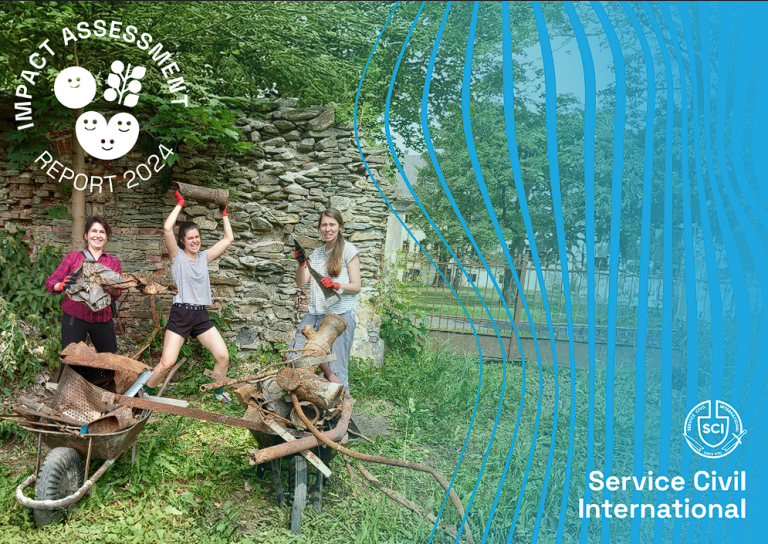
Impact Assessment Report 2024
The Impact Assessment Report 2024 shows what Service Civil International (SCI) is all about: creating a better world through peace, justice, and sustainable development, where volunteers grew personally, gained a deeper appreciation for other cultures, and strengthened their commitment to protecting our planet, where communities welcomed new ideas, embraced environmental action, built stronger connections across differences and together, we proved that even small actions can create meaningful change.
Download the full report and see the impact of SCI’s work in action.
Concept of Peace
When we talk about peace in SCI, we refer to the concept of positive peace, where different levels contribute to the attainment of true peace:

Inner Peace
Is sometimes referred to as “peace with myself”, or inner harmony, peaceful state of mind, and psychological well-being.

Peace with Others
Relates to the effects of our relationships, behaviours and communication towards other people and society at large. Living together in peace is about accepting differences and having the ability to listen to, recognize, respect and appreciate others, as well as living in a peaceful and united way.
Peace with Nature
Refers to the respect for the environment, a feeling of connection with nature, awareness of the link between one’s daily choices and the effect on the planet as well as the relationship between climate change and violent conflict, personal andcivic responsibility regarding sustainability, and active engagement in the protection of the planet.
Measuring impact at different levels
The framework assesses impact at three levels:

Participants
It focuses on personal growth areas such as inner peace, peace with others, and peace with nature. Indicators include self-awareness, self-esteem, inclusivity, and environmental consciousness.

Communities
It evaluates SCI’s impact within local communities, measuring cultural understanding, participation, and community perception of SCI’s work.

Environment
It analyses SCI’s environmental footprint, particularly in terms of CO2 emissions and broader sustainability efforts.
Participants
After their project…
55% of volunteers report significant changes in behaviour
62.5% notice a shift in their understanding of peace
Active
citizenship
+14% of volunteers “somewhat” or extremely likely to confront statements opposing peace and to advocate for peace activities
Peace
with nature
+12.6% of volunteers “somewhat” or extremely likely to try to change a friend’s or acquaintance’s mind about the value of peace activities
Communities
Positive contributions to communities
Interviews from Italy, Nigeria, and Australia show how volunteers and local partners are building inclusive spaces, strengthening communities, and fostering genuine intercultural exchange.
Peace, inclusion, and community development aren’t abstract ideals, they’re lived experiences made possible when people choose to volunteer with SCI.
“Working together on this project united us toward a common goal […] Volunteers made this project a reality, and their passion inspires us to keep contributing to social change.”
(VWAN Nigeria)
Environment
After their project…
100% of volunteers reported picking up
their trash/waste “most of the
time” or “always”
81.2%
of reported using bicycle and
public transportation more
+15.1%
Significant increase in buying local
and organic food
Conclusion
Across the three dimensins of Inner Peace, Peace with Others, and Peace with Nature, a unifying pattern emerges: learning in SCI workcamps is experiental, relational and transformative. Volunteers do not acquire peace as knowedge; they practice it through lived situations that demand reflections, cooperation, and care.
The impact is sustained over time, with volunteers interviewed after 6 months of their projects confirming the persistence of friendships, continued ecological habits, and follow-up involvement in local volunteering, and communities highlighting the lasting results of projects, especially when repeated over multiple years. However, the impact on the environment is an area that we need to evaluate more in the future.
SCI workcamps remain poweful instruments of non-formal peace education, fostering comprehensive learning that integrates emotional, social, and ecological dimensions. They also strenghten communities and enhance commitments to climate action. The findings underscore the enduring relevance of SCI’s century-old vision of peace through deeds.