Gendered realities
PROJECT DURATION
January – December 2019
The Idea
The Work Plan aims to better understand the different gendered realities existing in SCI activities. It addresses the topic in SCI globally and focuses on assessing how safe and inclusive our activities really are. It supports existing efforts of SCI members in the gender field, pools resources and particularly furthers the development of a toolkit which will support leaders to make their activities inclusive for all gender identities.
The activities
The Work Plan consisted of two international activities and a series of local follow-up actions. All the activities have successfully taken place.
International Study Session on Gender
Description of the training:
The first activity of Gendered Realities took place from 12-17 February in Tirana, Albania, where a group of 25 participants from more than 11 countries met for an International Study Session on Gender.
In the 5 days of training, participants had time to explore the topic of gender in detail, finding common understandings of key terms and concepts. With this as a basis, the group went on to discuss common experiences of gender-based discrimination and inequality within the context of volunteering. These conversations fed into methods for creating a ‘safe space’ in our activities.
To explore the specific context of the Albanian reality, the group went on study visits to two local organisations: an LGBTQI+ Centre and a Centre for Victims of Trafficking. They were able to discuss local issues in more depth during these visits. A guest speaker also offered insight into how gender roles are defined in parts of the Balkans, throughout history until today, through the study of ‘Sworn Virgins’.
Participants then worked on the following resources:
- Input on the gender toolkit, ‘Free to be You and Me’, which was finalised after the training;
- Creation of a new assessment tool for participants/volunteers, which was used to research common problem areas in SCI activities;
- Editing a self-assessment tool for organisations, developed by SCI Catalunya;
- Development of ideas for local follow-up activities.
Gendered Realities project is funded under the European Youth Foundation’s annual Work Plan, and the study session was co-funded by UNESCO’s Participation Programme.
Local Actions
14 local SCI groups run local actions, lasting between 1 to 10 days, which addressed a specific gender issue affecting their local reality.
Campaigning Training
A 6-day training to give participants the skills to construct and run a successful campaign. It was also a chance to review the project and bring together results achieved so far, and create a strategy for how to address these beyond the project’s lifetime.
Research: the Gender Assessment Tool
We have created an online gender assessment tool to understand how safe and inclusive SCI activities are when it comes to gender and sexuality. We asked ourselves:
– Does gender or sexuality affect people’s experiences at SCI activities?
– Are there situations or procedures that make people feel discriminated against based on their gender?
– Do people feel confident in recognising and addressing gender-based discrimination during SCI activities?
Please dedicate 15 minutes of your time to share your SCI experience in our online gender assessment tool.
Your contribution will help us gather data and testimonies about the experiences of individuals participating in SCI activities. We will use the outcomes of this research to identify areas for future attention and to take practical measures to keep improving the quality of SCI activities.
Who can take part? Volunteers (participants or coordinators) to SCI workcamps or international training courses/seminars from the past five years.
Resources
The project team has worked on 3 important resources: a toolkit, a survey with a booklet presenting the results, and gender-inclusive labels.
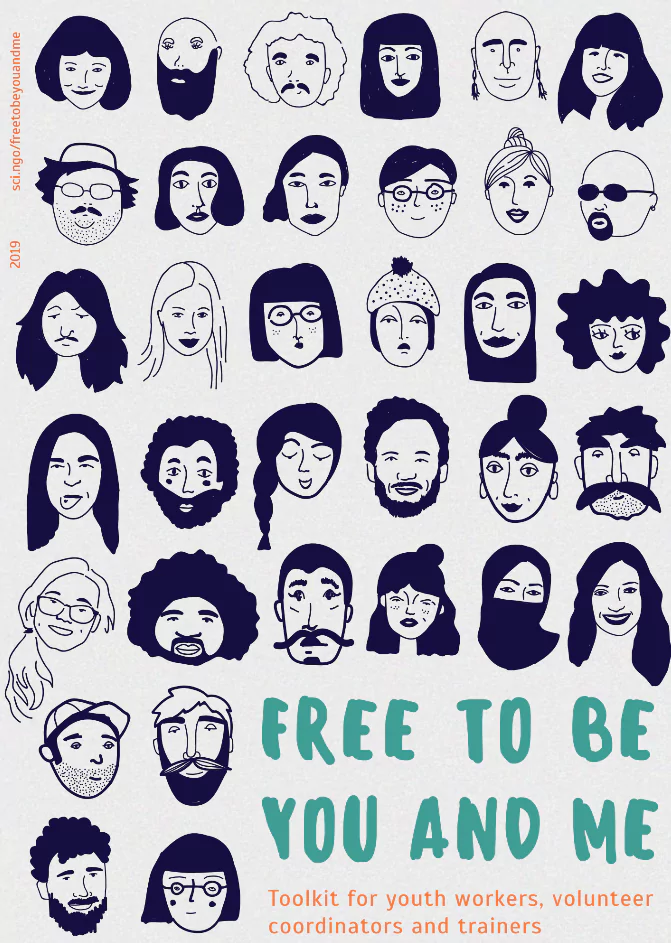
Free to be You and Me, toolkit on gender
The toolkit provides comprehensive information on gender and sexuality, along with practical guidelines and easy-to-use tools, with the aim of helping leaders to address the topic of gender and sexuality in their activities. It is hoped that this will be a tool which helps to make activities more safe and inclusive for all, regardless of gender identity or sexuality.
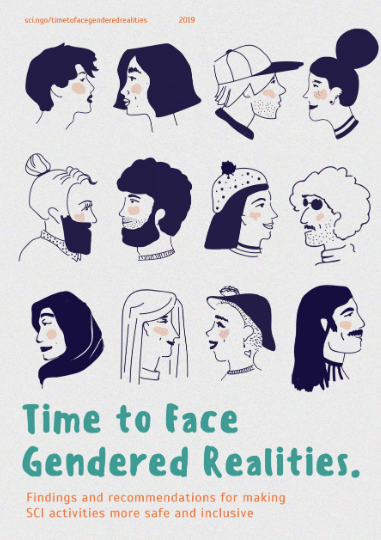
Time to Face Gendered Realities, booklet
The booklet summarizes the results of a survey that took place between June and September 2019 and that, through the Gender Assessment Tool, collected the input of 119 SCI volunteers and activists. The objective of the survey was to understand how safe and inclusive SCI activities are when it comes to gender and sexuality by looking at the experiences of participants in different SCI activities. It also provides recommendations to the SCI movement on how to rethink its daily practices and activities in order to make them fully safe and inclusive for all.
Time-to-Face-Gendered-Realities, name tags
These name tags can be used by trainers, youth workers, coordinators and anyone who would like to include a gender perspective in their activities, by encouraging participants to think about gender as a spectrum and not as a binary (male/female) concept, and giving the opportunity to open up the conversation.
Funders
The Gendered Realities project is supported by the European Youth Foundation of the Council of Europe, and the first activity is co-funded by the Participation Programme of UNESCO.
The project was carried out by an international project team in collaboration with the Gender Blenders Working Group and volunteers from 12 project countries.